
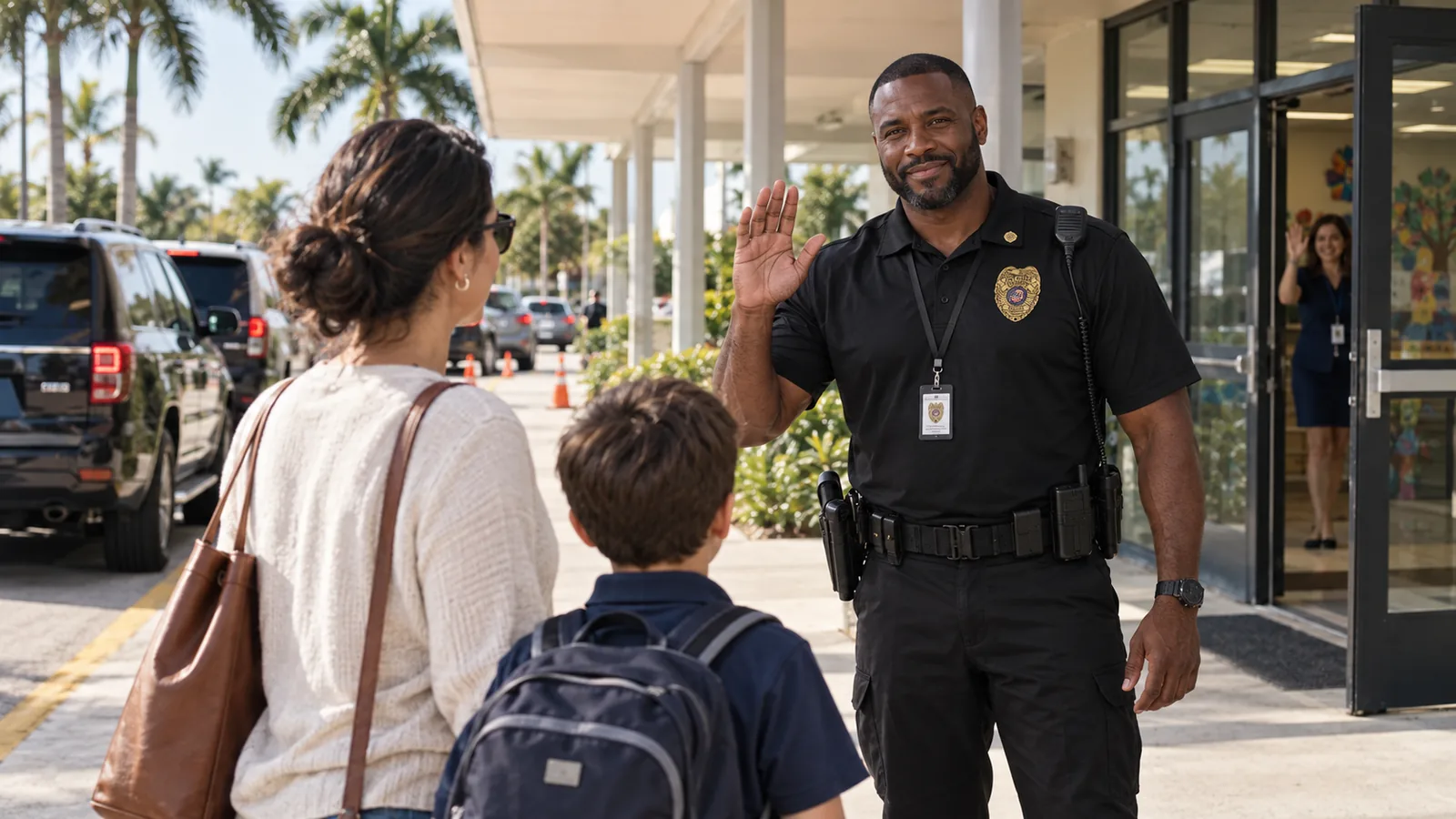
A private K-8 school in Broward County with about 400 students and a campus of several buildings around a courtyard asked FSO Guard for two things. The first was an armed officer on campus during school hours, after parents had pressed the board for one. The second was help with morning drop-off and afternoon pick-up, where a line of cars backed onto a busy road and parents walked children across it between moving vehicles. The head of school put it plainly: she wanted the parents to stop calling.
Client details are confidential. The school’s name, location and dates are withheld and some figures are rounded. The profile reflects private school assignments FSO Guard runs in Broward and Miami-Dade.
What we found on the site visit
Two entrances were open during the day: the main office door, where a receptionist buzzed people in, and a side gate by the gym that teachers used and left unlatched. Visitors signed a paper book and were rarely asked for ID. The pick-up line had no cones, no staff and no rule about which lane cars used. The campus had good cameras that nobody watched during the day, and no written procedure for a parent who was not allowed to collect a child, although the front office knew of at least two such cases.
The plan agreed with the head of school
- One entrance. The side gate was fitted with a self-closing latch and an alarm contact and became exit-only during the day. Everyone, including staff, came through the main office.
- One Class G armed officer, 7 a.m. to 4 p.m. Uniformed, at the main entrance during arrival and dismissal and on a perimeter and building walk between them. Camera monitor at the front desk.
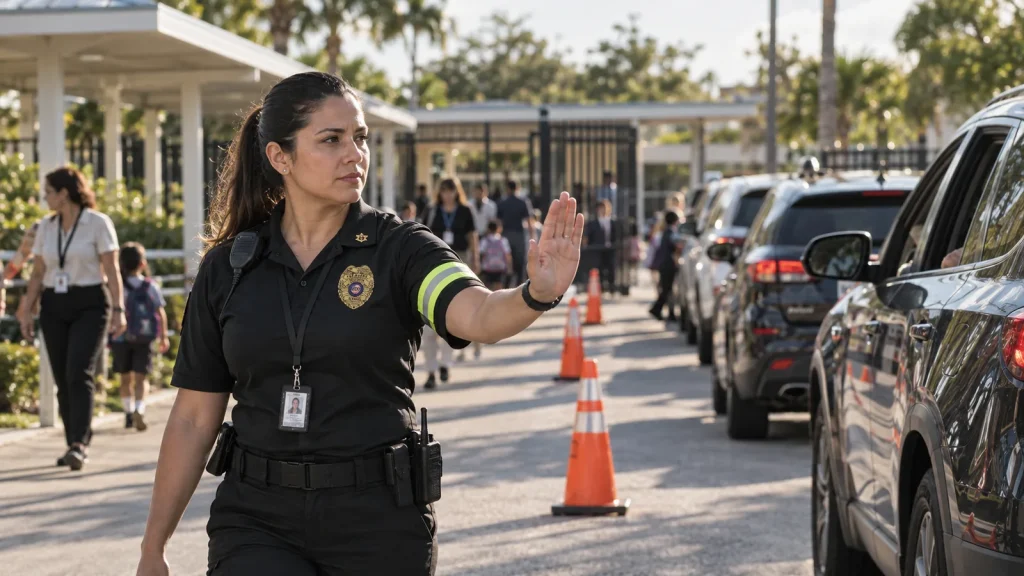
- A second officer for dismissal, 2 p.m. to 4 p.m. Traffic: cones, a single-file lane, children walked to the car by staff, no parking on the road.
- Visitor screening. Photo ID checked against the school’s approved-visitor and volunteer list; a printed badge; escort to the classroom by staff, not by the officer, who stays at the door.
- Restricted-adult procedure. A one-page document with the school’s list, court orders on file in the front office, and a script for the officer: keep the child inside, call the head of school, call police if the adult stays.
- Emergency roles. The officer’s role in the school’s lockdown and evacuation drills was written into the school’s own plan, and the officer took part in the first drill within two weeks.
The first month
The traffic problem was solved in a week. Cones, a lane and a person in a uniform telling parents where to stop did what two years of emails had not. Complaints to the board about the pick-up line stopped.
The restricted-adult procedure was tested in the fourth week. A parent who was not authorized to collect his child arrived at dismissal, on foot, and asked for the child by name. The officer, who had the list, said the child would stay inside, asked the parent to wait by the office and called the head of school. The parent raised his voice; the officer did not. The head of school came out, the conversation moved into the office and away from other children, and the parent left after about ten minutes. Police were not needed. The incident report, with times, went to the head of school the same afternoon and, at her request, to the school’s attorney.
The officer also found, in the first two weeks, three exterior doors that did not latch and a gap in the rear fence behind the gym. The school fixed all four. Nobody had walked the perimeter with a checklist before.
What the school received
A daily activity log, incident reports when there was something to report, a visitor log the school could produce for its accreditation review, and a written campus security review after 30 days with a short list of physical fixes, most of which cost little. The board received a summary once a quarter. Two years on, the same officer is on the campus, which is what the school asked for and what matters most: the children know him.
What we would do differently
We would ask for the drill schedule earlier. The first lockdown drill happened before the officer’s role had been explained to every teacher, and one teacher did not know whether to open the door for him. It was a drill, so it cost nothing, and it is now the first question on the school checklist.
Related services
This assignment is our school and campus security service with a Class G armed officer, and it borrows the access-control approach we use for churches and places of worship. Schools that need a formal risk assessment before hiring can start with our security consulting and risk assessment. To arrange a campus visit anywhere in Broward or Miami-Dade, call 888.881.8099 or send a request. More assignments: all case studies.