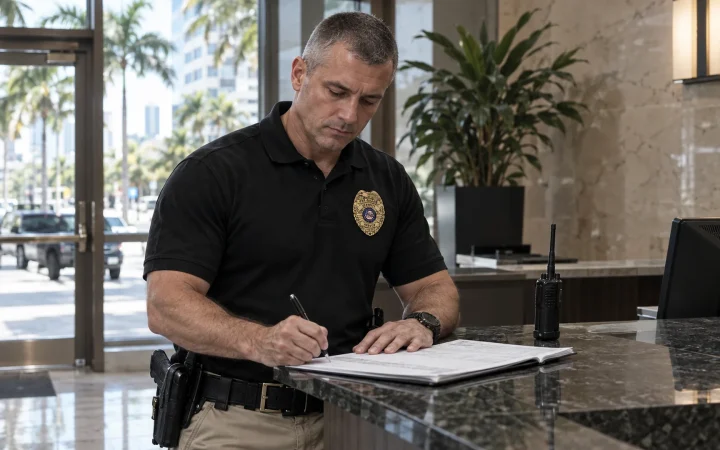

People rarely ask a private investigator’s price with a light heart. Usually there is a marriage in doubt, a custody dispute, a missing person, a business partner who is not what they seemed, or an employee stealing. This guide explains how much a private investigator costs in Florida — how billing works, what surveillance really costs, which services are flat-fee, what pushes the price up or down, and how to compare quotes without getting burned.
How private investigators charge
Hourly rates
Most investigative work — surveillance, interviews, field work, case analysis, report writing — is billed per investigator per hour. Two-investigator surveillance (needed when a subject moves through traffic, uses multiple vehicles or when a single vehicle would be noticed) doubles the hourly cost but often halves wasted time.
Retainers
A retainer is paid up front and drawn down as hours and expenses accrue. You receive itemized statements; the unused balance is returned or applied to the next phase.
Flat fees
Background checks, skip tracing and locates, process service, record retrievals and some GPS and technical services are commonly quoted as a flat fee per subject or task.
Expenses
Mileage, tolls, parking, database access fees, court record copies, travel outside the metro area and equipment such as GPS units or covert cameras are typically billed at cost or a stated rate. Ask for them to be listed in the estimate.
What each type of investigation typically involves
| Service | How it is billed | What drives the cost |
|---|---|---|
| Infidelity / domestic surveillance | Hourly, 4-hour minimum sessions, retainer | Number of sessions, one or two investigators, nights and weekends, subject’s mobility |
| Child custody investigation | Hourly + report and testimony | Duration of observation, documentation standard for court, attorney coordination |
| Background check | Flat fee per subject | Depth: identity and criminal only vs. full civil, assets, employment, social media |
| Skip tracing / locate a person | Flat fee or hourly | How old the information is, whether the person is avoiding contact |
| Corporate investigation / due diligence | Hourly or project fee | Number of entities and people, jurisdictions, interviews, forensic review |
| Employee theft / workplace | Hourly, sometimes covert placement | Duration, covert cameras, interviews, coordination with HR and police |
| Insurance / claims surveillance | Hourly, often per-day blocks | Days of observation, video standard, reporting to adjuster or attorney |
| GPS tracking (lawful, on vehicles you own) | Device + monthly monitoring | Device type, monitoring period, investigator analysis |
| Bug sweep / TSCM | Flat fee by area or hourly | Square footage, vehicles, number of rooms, equipment required |
| Process service | Flat fee per attempt or per serve | Rush service, evasive subjects, distance |

Seven things that move the price
- Type of work. Surveillance and field work are hourly; database work is cheaper per result; expert testimony and specialized technical work are more expensive.
- Time of day and week. Nights, weekends and holidays — when most domestic surveillance happens — cost more.
- One investigator or two. Mobile subjects in Miami traffic often require two vehicles.
- How much you already know. A subject’s schedule, vehicle and addresses cut wasted hours dramatically.
- Documentation standard. Evidence for your own peace of mind is cheaper than evidence for a family court, which needs chain of custody, detailed reports and possibly testimony.
- Location. Work outside Miami-Dade, Broward and Palm Beach adds travel time.
- Urgency. Same-day or next-day starts cost more than scheduled work.
How to keep the cost down without weakening the case
- Bring what you have. Photos, vehicles, plates, addresses, schedules, social media handles, prior incidents.
- Define the question. “Is my spouse seeing someone on Thursday evenings” is cheaper to answer than “find out everything.”
- Start with desk work. Background and database research often answers part of the question before anyone sits in a car.
- Set a budget and checkpoints. Agree on a first phase and review results before authorizing more hours.
- Do not do it yourself illegally. Placing a tracker on a car you do not own or accessing someone’s phone is a crime in Florida and can destroy your case. Read what GPS tracking is lawful.
Licensing: the question to ask before price
In Florida, private investigators must hold a Class C license (or work as a Class CC intern under supervision) and operate under a licensed Class A investigative agency. Ask for the license numbers and verify them on the Florida Department of Agriculture and Consumer Services licensing portal. Unlicensed investigation is illegal, and evidence gathered by an unlicensed person can be challenged or excluded. Licensed agencies also carry insurance and are accountable to the state — that accountability is part of what you pay for.
Getting an accurate quote
A licensed agency will offer a confidential consultation, ask what you need to know and why, tell you what is legally possible, and give you a written estimate with the hourly rate, minimums, expected sessions, retainer and expenses. If a quote is a single vague number with no breakdown, keep looking.
FSO Guard’s licensed investigators handle surveillance, domestic and custody matters, background checks, locates, corporate and workplace investigations and lawful GPS tracking across South Florida — with English, Spanish and Russian speaking investigators. Learn more about our private investigator services, or call (786) 659-5011 for a confidential consultation and a written estimate.