Guests remember a great event; they only remember security when something goes wrong. The difference is almost never the guards on the night — it is the plan written two or three weeks before. This guide walks through event security planning the way a licensed agency does it, from risk assessment to the debrief, with a checklist at the end.
Step 1. Define the event honestly
Write down: date and hours, venue and layout (indoor, outdoor, multiple areas), expected attendance and peak, guest profile (invited or ticketed, public or private), alcohol service, cash handling, performers or speakers, VIPs or public figures, media presence, anything controversial, and what has gone wrong at previous editions. Every staffing decision comes from this page.
Step 2. Risk assessment
Rank realistic risks, not movie plots: uninvited guests and gate-crashers, intoxication and fights, theft (gifts, bags, equipment, phones), medical emergencies, crowd crush at entrances or the stage, weather (South Florida storms), protest or disruption, a specific threat against a person, and vehicle access to pedestrian areas. For each: how likely, how bad, and what control addresses it. This is what turns “we need some security” into a specific plan.
Step 3. Site walk and layout
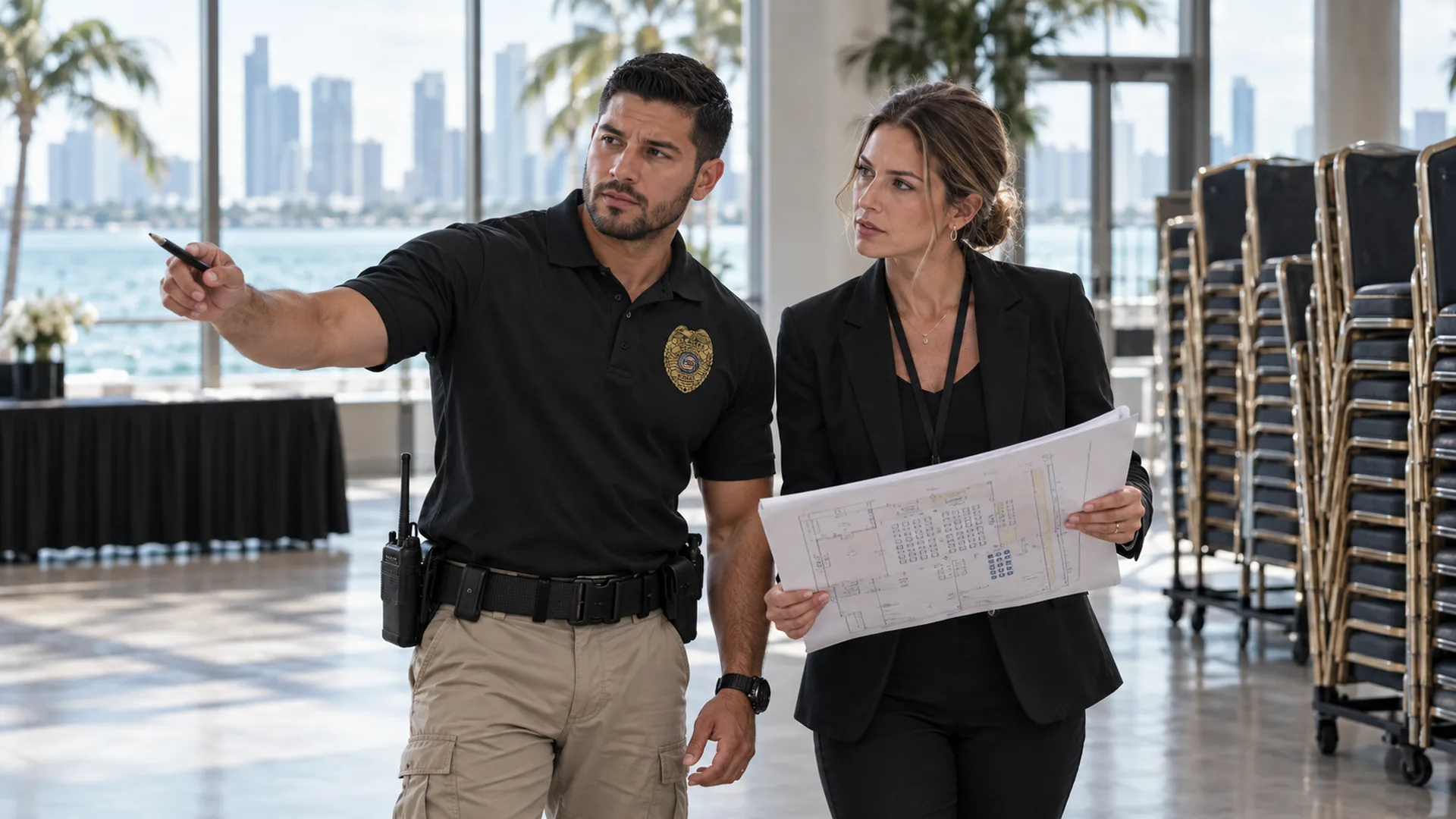
Walk the venue with the security lead. Mark every entry and exit, emergency exits and whether they are alarmed, where lines will form, sightlines, dark or hidden areas, the stage or head-table approach, back-of-house and loading dock, cash points and coat check, parking and drop-off, and where a vehicle could reach a crowd. Decide where fixed posts go and how roving officers move.
Step 4. Staffing
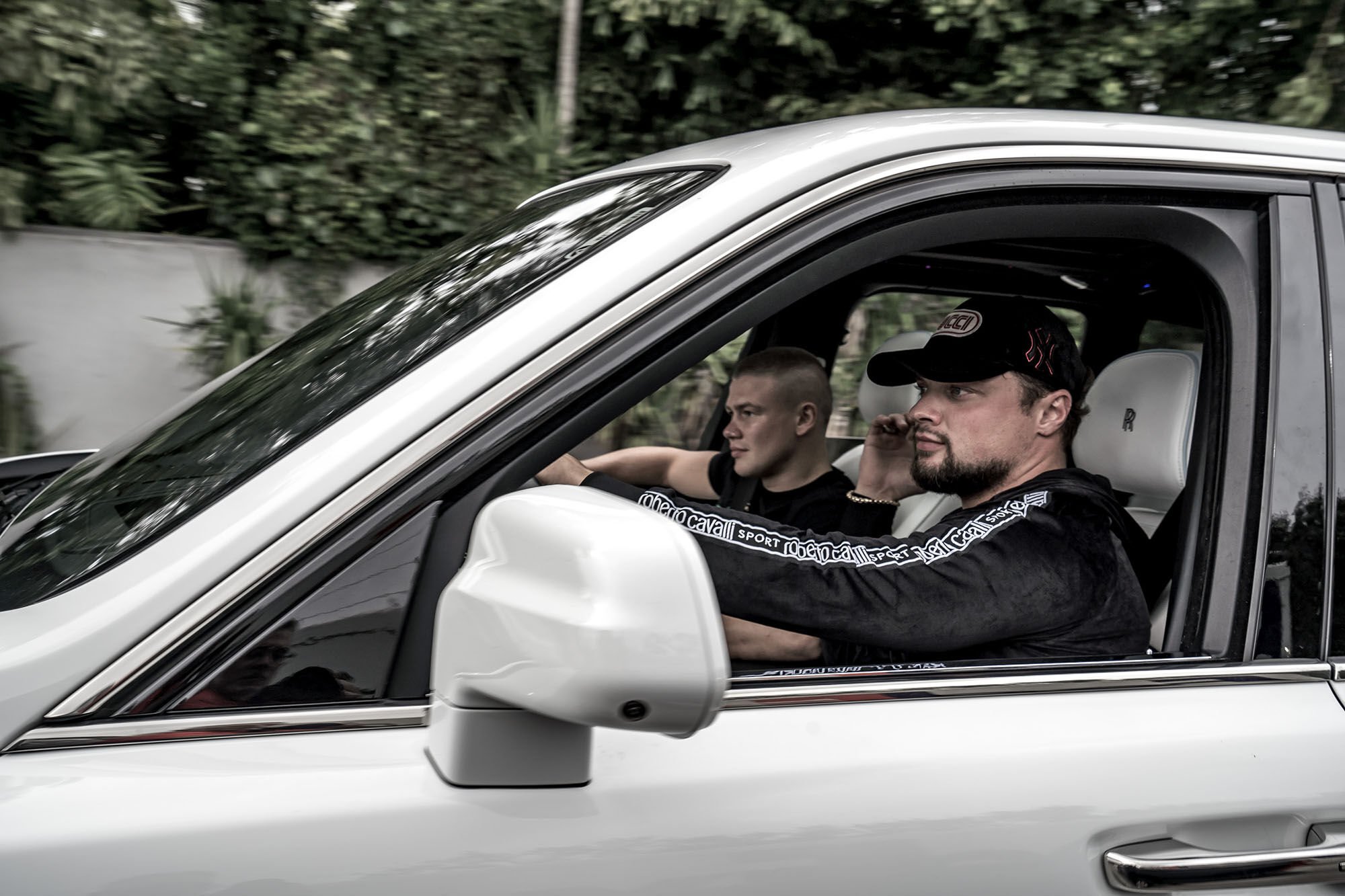
Build the roster from posts, not from a ratio: each entrance, screening lane, stage or VIP area, cash point, back-of-house door and parking area needs a body for the hours it operates, plus roving officers for the floor and a supervisor for anything over a handful of officers. Then sanity-check against attendance. Typical starting points are about one officer per 50–100 guests for seated private and corporate events, one per 50 or fewer where alcohol and a standing crowd combine, and denser for nightlife and festivals. Add close protection for named VIPs and female officers for screening and family areas. See event security guards for how we build a team.
Step 5. Entry and credentials
- One controlled entrance for guests; all other doors exit-only or staffed.
- Guest list or ticket scanning at the door, with a manager empowered to resolve disputes so officers do not.
- Screening policy decided in advance and posted: ID check, bag check, wanding, prohibited items. Consistent and non-discriminatory.
- Credentials for staff, vendors, performers and VIPs — colored wristbands or badges that cannot be photographed and reproduced in an hour.
- Re-entry rules and a plan for lines: shade, water and a visible officer keep a queue calm.
Step 6. Crowd flow and capacity
Know the legal capacity and count in and out. Keep aisles and exits clear all night. Plan the surge moments — doors open, headliner, bar last call, exit — with extra officers positioned before they happen. For stages, a barrier line and officers facing the crowd, not the show.
Step 7. Alcohol
Most event incidents are alcohol incidents. Coordinate with bar staff on refusing service, place an officer near the bar at peak, plan how intoxicated guests are handled (a quiet word, a seat, water, a ride — not a confrontation) and how they get home. For weddings and private parties, brief the host on who makes the call to cut someone off.
Step 8. VIPs and high-profile guests
Separate arrival and departure route, a holding room, a dedicated agent, and a plan for photographs and fans. Coordinate with the guest’s own security if they bring one. Never announce arrival times publicly. See VIP security.
Step 9. Emergency plan
One page everyone reads: medical response and the nearest hospital, fire and evacuation routes with assembly point, severe weather trigger and shelter, lost child procedure, active threat response, and who calls 911 and who meets responders. Radios on a shared channel, a written communications tree, and a pre-agreed code for “stop the music”.
Step 10. Coordinate with the venue, police and vendors
Confirm in writing what the venue’s security covers and where it stops. For large public events, notify the local police department and ask about off-duty details or traffic control; for street closures or vehicle barriers, involve the city early. Brief caterers, production and valet on the credential system and the emergency plan.
Step 11. Brief, run, debrief
Officers arrive early for a briefing with the plan, the map, credentials and the do-not-admit list. A supervisor logs incidents through the night. Afterwards, a short debrief: what happened, what nearly happened, what to change next time. The report protects you if there is a claim.
Printable checklist
- ☐ Event profile written (date, venue, attendance, alcohol, VIPs, cash, media)
- ☐ Risk assessment with controls for each risk
- ☐ Site walk done; posts marked on a map
- ☐ Roster by post and hour; supervisor assigned
- ☐ Entry policy posted; guest list/ticketing and dispute manager set
- ☐ Credentials designed and distributed to staff, vendors, VIPs
- ☐ Capacity known; counting method agreed
- ☐ Alcohol plan with bar staff; ride-home options
- ☐ VIP arrival/departure routes and holding room
- ☐ Emergency plan on one page; radios and channel tested
- ☐ Venue, police and vendors briefed in writing
- ☐ Officer briefing scheduled; incident log ready
- ☐ Security company license verified (Florida Class B) and certificate of insurance received
Event security in Miami, Fort Lauderdale and Palm Beach
FSO Guard plans and staffs event security for corporate events, weddings, galas, festivals, nightlife and private parties across South Florida — licensed (Florida Security Agency License B3100530), insured, with supervisors and officers in English, Spanish and Russian. Send us your date and a rough guest count at (786) 659-5011 or on WhatsApp and we will come back with a plan and a written quote. Related: how event security works in Miami.