
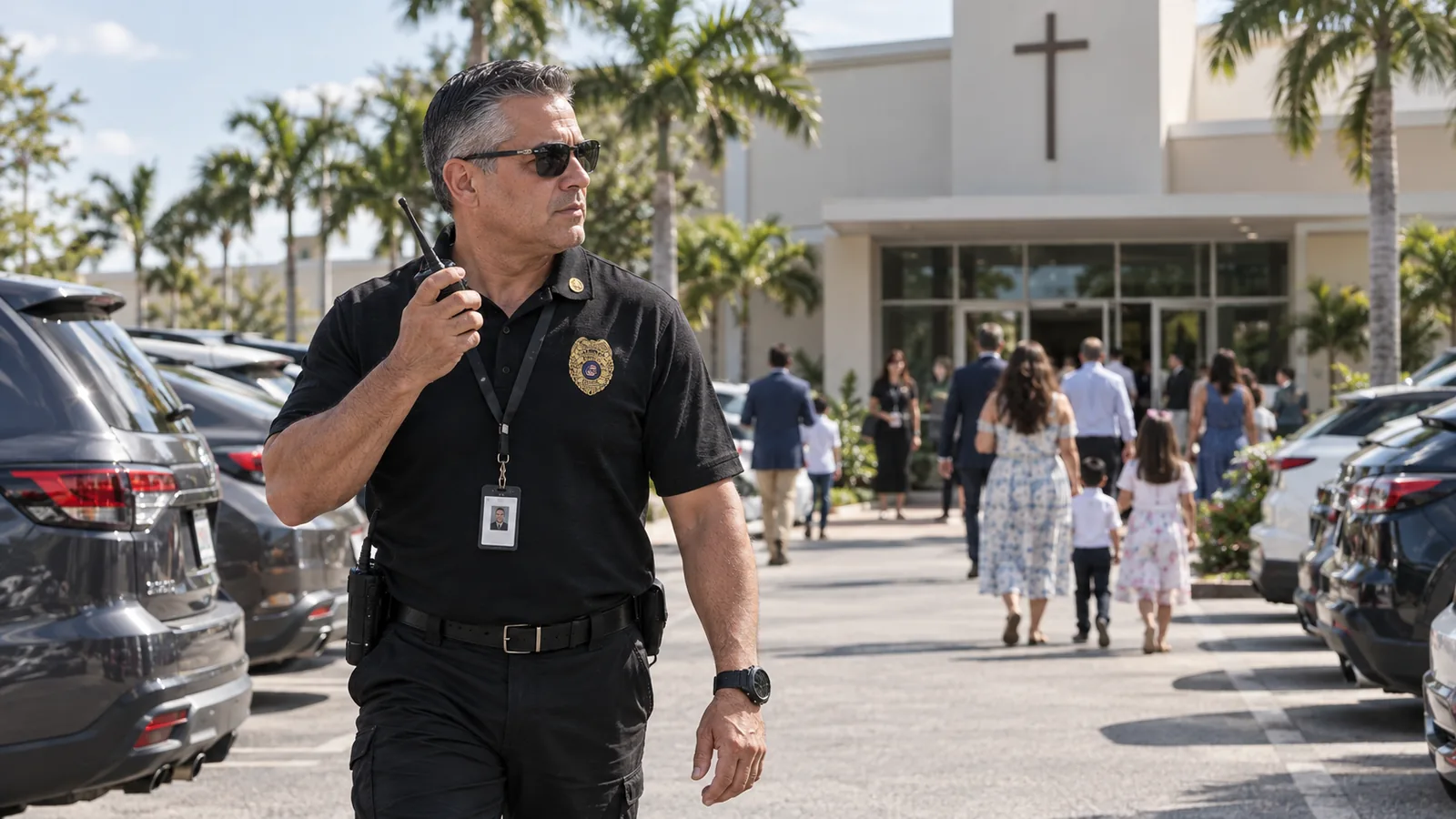
The pastor of a church in Hollywood, Florida, with about 600 regular members across two Sunday morning services, called FSO Guard after two things happened in the same month: three cars were broken into in the parking lot during the second service, and a man nobody recognized walked into the children’s wing and was asked to leave by a volunteer who had no idea what to do if he refused. The pastor wanted the congregation protected without turning worship into something that felt guarded.
Client details are confidential. The church’s name, location and dates are withheld and some figures are rounded. The profile reflects church and place-of-worship assignments FSO Guard runs in Broward and Miami-Dade.
What we found on the site visit
We visited on a Sunday, sitting through the first service and standing in the parking lot during the second. The sanctuary had three sets of doors, all unlocked and unwatched once the service began. The children’s wing had two entrances, one from the sanctuary lobby and one from the parking lot, and check-in was a sign-in sheet. The parking lot was large, dark on the far side and out of sight of the lobby. Eight volunteers served as greeters and ushers, all friendly, none briefed on what to do with a problem. The offering was counted in the pastor’s office and driven to the bank by the treasurer, alone, on the same route every Monday.
The plan agreed with the pastor and the elders
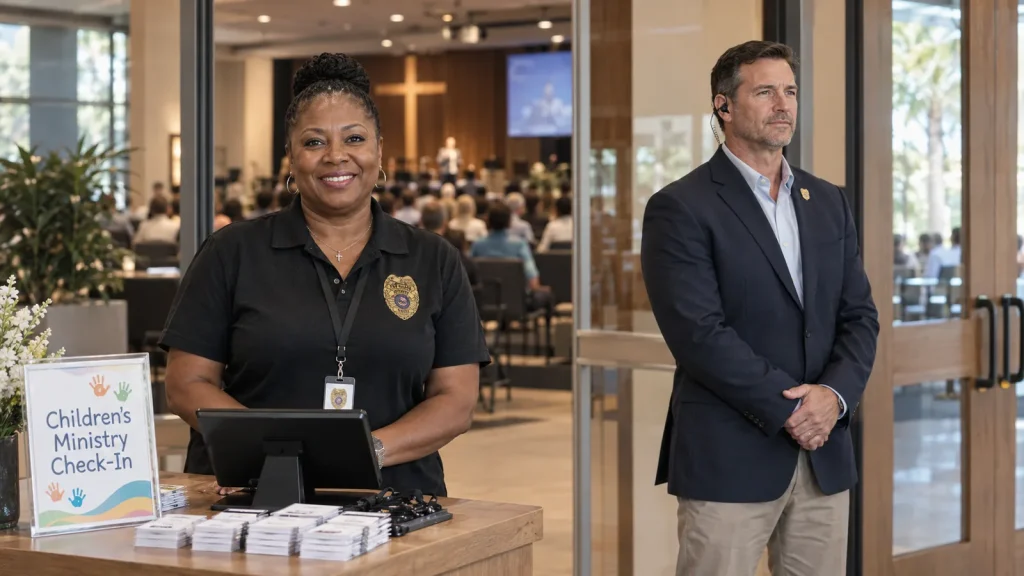
- Inside: one Class G armed officer in plain clothes, seated at the rear of the sanctuary with a view of all three doors, from 30 minutes before the first service to 30 minutes after the second. Dressed like a member. Radio earpiece.
- Outside: one uniformed Class D officer in the parking lot, walking the far side, greeting arrivals, watching for anyone circling cars, and covering the children’s wing’s outside door during services.
- Doors. Once a service begins, two of the three sanctuary doors are closed and monitored by an usher; late arrivals use the lobby door, where a greeter stands.
- Children’s wing. One entrance during services, tag-based check-in and check-out, a volunteer who knows the families at the door, the outside door alarmed and exit-only. The officer walks past every 20 minutes.
- Volunteer safety team. A 90-minute session with the eight greeters and ushers: what to watch for, how to approach someone agitated, how to call the officer with a radio phrase, and the one rule that matters most: never put hands on anyone.
- Offering. Counted by two members in a locked room, sealed, escorted to the bank on Monday by an officer who drives, on a route that changes.
How the first months went
The parking lot break-ins stopped with the first uniformed Sunday and have not returned in the time we have covered the church. That is the least surprising result in this profile: a person in a uniform walking a parking lot is the oldest deterrent there is, and it works.
The children’s wing was tested once, six weeks in, when a grandparent who was not on the child’s pick-up list arrived to collect her. The volunteer at the door followed the procedure, asked her to wait and radioed. The plainclothes officer walked over, the parents were found in the sanctuary, and the situation was resolved as a family misunderstanding in about five minutes. The volunteer said afterwards that it was the first time she had known exactly what to do.
There was one situation the pastor had feared: a man in visible distress during the second service, standing up mid-sermon and speaking loudly. The officer did not move first. An usher, following the training, walked to him and quietly asked if he would step into the lobby to talk; he did, and the officer followed at a distance and stayed in the lobby while the usher and later the pastor spoke with him. He left calmly. The service continued. Most of the congregation did not know anything had happened, which is exactly how the pastor wanted it.
What the church received
A weekly one-paragraph report to the pastor, incident reports on the two occasions there was something to report, a written security review with recommendations after 60 days (lighting on the far side of the lot, a camera at the children’s wing outside door, an alarm contact on the sanctuary side doors) and the volunteer training, which the church has since repeated for new greeters on its own. The church also asked us to cover Christmas Eve and Easter, when attendance doubles, with a third officer.
What we would do differently
We would hold the volunteer training before the first Sunday, not during the second week. The greeters were the most important part of the plan and they spent one Sunday knowing an officer was present without knowing how to reach him. It cost nothing that time; it is now the first thing on the church checklist.
Related services
This assignment is our church and place of worship security service with a plainclothes Class G armed officer and a uniformed Class D officer. For a step-by-step guide to building a plan like this one, read how to write a church security plan in Florida. Holiday services and larger gatherings fall under event security. To arrange a visit to your church in Hollywood or anywhere in South Florida, call 888.881.8099 or send a request. More assignments: all case studies.