Give backstage permissions a single owner
Backstage security becomes difficult when production, talent representatives, venue staff and vendors all issue different instructions. Establish which event representative owns the access list and who can approve an exception. Provide a reachable alternate during performances and changeovers.
Define permissions by the task and area, not by prestige. A performer’s guest, a delivery worker and a technical crew member may have different legitimate needs. Staff should apply the current permission rather than infer access from confidence or familiarity.
Prepare the credential and work schedule together
The production schedule should identify expected crew and vendor activity, with the appropriate approval route. Credentials need a clear period of validity and an understood relationship to work areas.
Keep sensitive artist schedules and private-room details restricted. Staff at a checkpoint need enough information to apply their assignment; they do not need unrestricted copies of every production document. Give updates through one designated channel so outdated screenshots do not become competing instructions.
Handle last-minute changes deliberately
A replacement technician, additional guest or delayed delivery can be legitimate. Verify the request with the authorized production contact and record the decision. Explain where the person should wait while the change is reviewed.
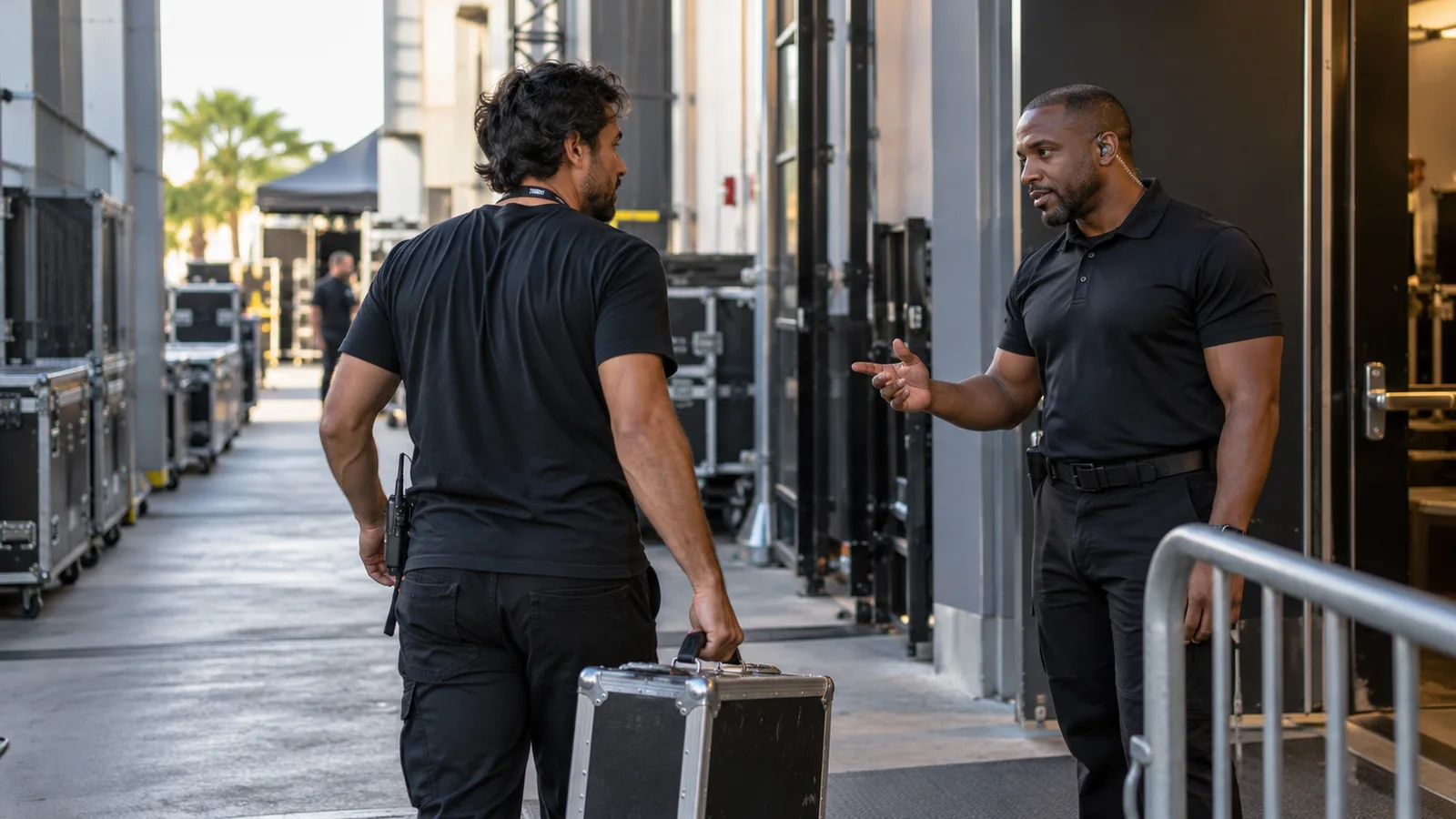
Do not allow urgency alone to expand access. A case marked for a performer does not prove that the person carrying it may enter a private area. Coordinate equipment movement with the venue and production teams without asking security staff to make technical stage-safety decisions.
Keep communication clear during the show
Brief staff on contact names, radio discipline, relevant schedule changes and when to escalate a concern. Use factual descriptions and avoid broadcasting unnecessary personal information. Ensure that a staff member can request assistance without abandoning an assigned entrance.
An access dispute and an immediate safety threat require different responses. The plan should identify the relevant support for each. Security personnel should act within their training and the event’s approved procedures, with emergency services contacted when appropriate.
Close permissions after the final cue
Load-out can involve different personnel and access needs from the performance. Confirm the authorized collection process and who remains responsible for production decisions. Do not assume that every daytime credential remains valid indefinitely.
Reconcile temporary keys, badges and outstanding exceptions. Record any relevant incident and transfer unresolved property issues to the designated venue representative. A clean closeout gives the next event a reliable starting point rather than a stack of unexplained passes.
Quick review checklist
- Production access owner
- Role-specific current permission
- Verified last-minute changes
- Working support contacts
- Load-out and credential closeout
Put the process into your site plan
Use this guide alongside our article on Conference Badge Security. To discuss the responsibilities, operating conditions and coverage your property or event needs, contact FSO Guard about the appropriate security scope.
Frequently asked questions
Does an all-day event badge mean unlimited backstage access?
Only if the event’s actual permission scheme says so. Access should reflect the approved role, area and validity period.
Who can approve a replacement crew member?
The designated production or event representative. Checkpoint staff should verify the change through the approved contact route.
Why plan load-out separately?
Collection activity, personnel and responsibilities can change after the performance. Explicit permissions prevent daytime assumptions from continuing unchecked.