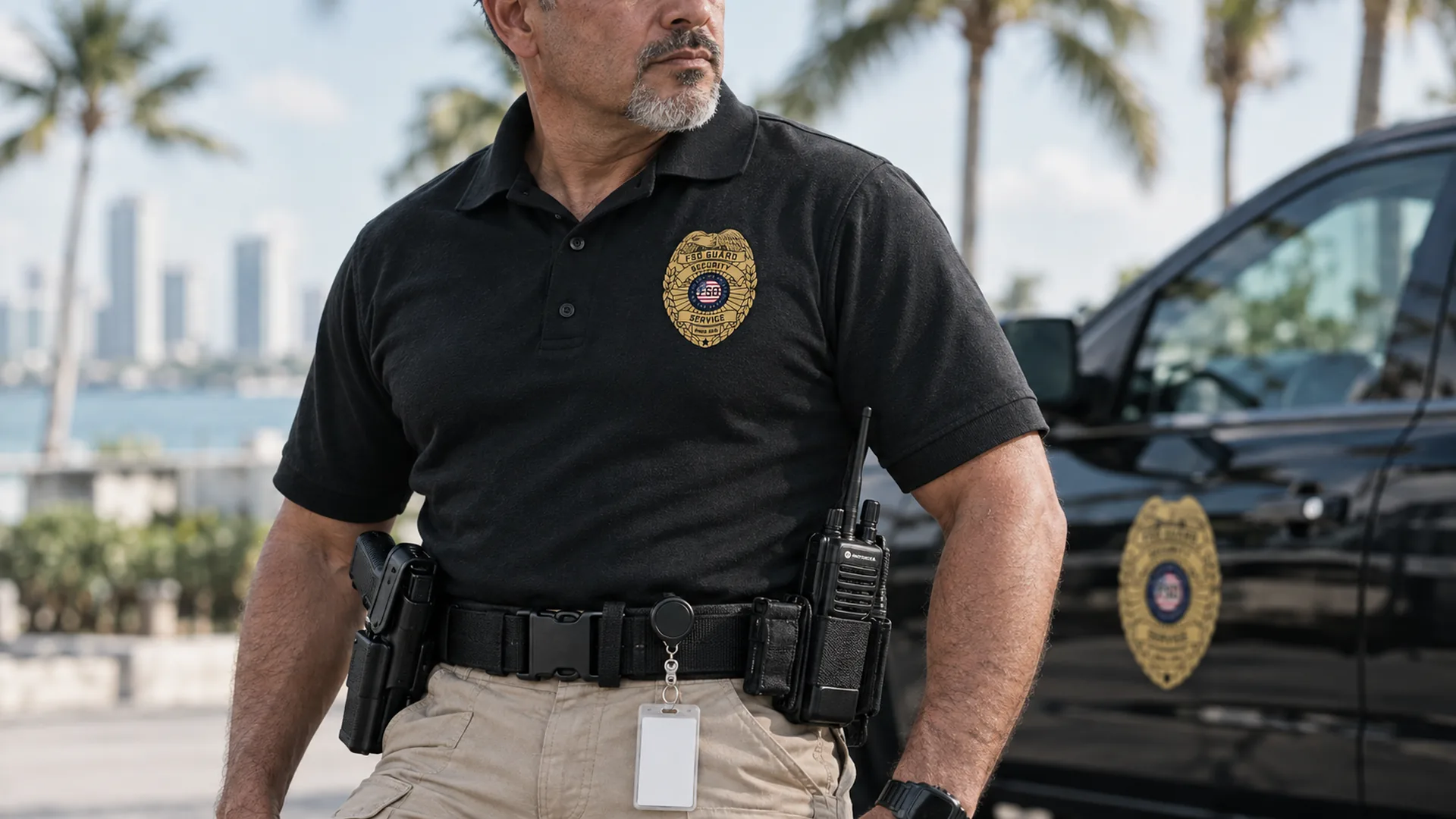
Search for a security company in Miami and every website says “licensed and insured.” Fewer show a license number, and fewer still explain what it means. Florida regulates the entire industry under Chapter 493 of the Florida Statutes through the Department of Agriculture and Consumer Services (FDACS), and each license class authorizes something specific. This guide explains the Florida security and investigative license classes, how to verify any company or officer, and why hiring an unlicensed one is a liability you do not want.
The license classes at a glance
| Class | Who holds it | What it authorizes |
|---|---|---|
| B | Security agency (the company) | Providing security officers and related services for hire. Requires a licensed manager (Class M or MB) and proof of insurance. |
| BB | Security agency branch office | Each additional office of a Class B agency. |
| D | Security officer (individual) | Working as an unarmed security officer for a licensed agency. State-mandated training, fingerprints, state and federal background check. |
| G | Armed individual (add-on) | Carrying a firearm while on duty as a Class D officer or Class C investigator. Firearms training and annual requalification. Not a standalone license. |
| A | Private investigative agency (the company) | Providing investigative services for hire — surveillance, background investigations, locates, asset searches, process-related investigations. |
| C | Private investigator (individual) | Conducting investigations for a Class A agency. Requires experience or education plus examination. |
| CC | Private investigator intern | Investigating under the sponsorship of a Class C investigator while accumulating experience. |
| M / MA / MB | Manager | Managing the day-to-day operations of an agency (MA — investigative, MB — security, M — both). |
| DI / DS | Instructor / school | Teaching the required Class D and G courses. |
Two practical takeaways. First, a company needs an agency license (B for security, A for investigations) and every person on your property needs an individual license (D, and G if armed). Second, a security agency cannot legally sell investigations without a Class A license, and an investigative agency cannot post guards without a Class B. FSO Guard holds both — B3100530 and A 1000095 — which is why we can put an officer at your gate and an investigator on your case under one contract.
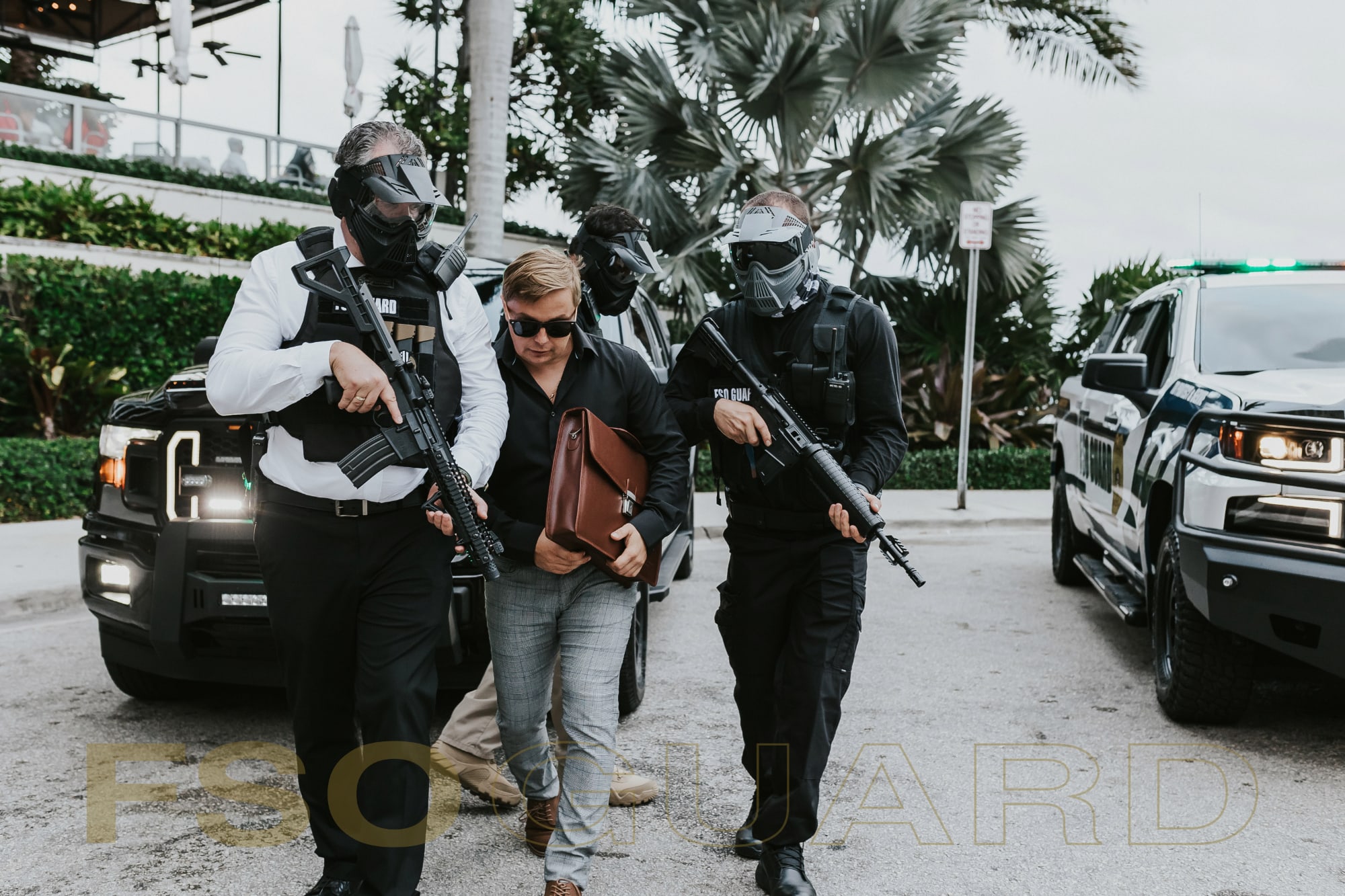
How to verify a security company in two minutes
- Ask for the agency license number. A legitimate company gives it instantly; it is on their proposals and, ideally, their website.
- Go to the FDACS Division of Licensing public lookup (search “FDACS license lookup” — the official site ends in fdacs.gov).
- Search by license number or business name. Check three things: the class matches the service (B for guards, A for investigations), the status is active, and the name and address match the company you are talking to.
- For the officers assigned to you, ask for their Class D (and G) license numbers or to see the license cards. Officers must carry them on duty.
- Ask for a certificate of insurance naming you as certificate holder. Class B agencies must carry liability insurance; a reputable company will issue the certificate before the first shift.
Red flags of an unlicensed operator
- “Licensed and insured” with no number anywhere, or a number that does not appear on the lookup.
- A license from another state or a certificate from a training school presented as a license.
- Guards paid in cash, hired as “independent contractors” with no agency, or provided by a staffing or cleaning company.
- Armed “security” whose only qualification is a personal concealed-carry permit.
- A security company that also offers to “find out who someone really is” without a Class A license.
- Prices dramatically below every other quote — licenses, insurance, training and payroll taxes are exactly what the discount skips.
Why it matters to you, not just to the state
When an incident happens on your property — a use of force, an injury, a theft by a guard, a shooting — the questions are: was the agency licensed, were the officers licensed and trained, was the firearm authorized, and is there insurance. If the answer to any of them is no, the liability lands on the property owner, the event organizer or the business that hired them. Evidence gathered by an unlicensed investigator is also worthless in court and can expose the client to claims. A license is not a formality; it is the paperwork that stands between you and a lawsuit.
What licensing does not guarantee
A license is the floor, not the ceiling. The state minimum training for a Class D officer is measured in hours, not weeks. What separates good companies from adequate ones is what they add: site-specific post orders, de-escalation and customer service training, supervision with unannounced visits, GPS-verified patrols, stable staffing and honest scoping. Our guides on what a security guard actually does and how to choose a security company in Miami cover those questions.
Licensed security and investigations in South Florida
FSO Guard Security Company — Florida Security Agency License B3100530, Private Investigative Agency License A 1000095, office at 1716 N Dixie Hwy, Hollywood, FL 33020 — provides licensed security officers, armed Class G officers and licensed private investigators across Miami-Dade, Broward and Palm Beach. Call (786) 659-5011 or message us on WhatsApp; we will send our license numbers and certificate of insurance with the quote.