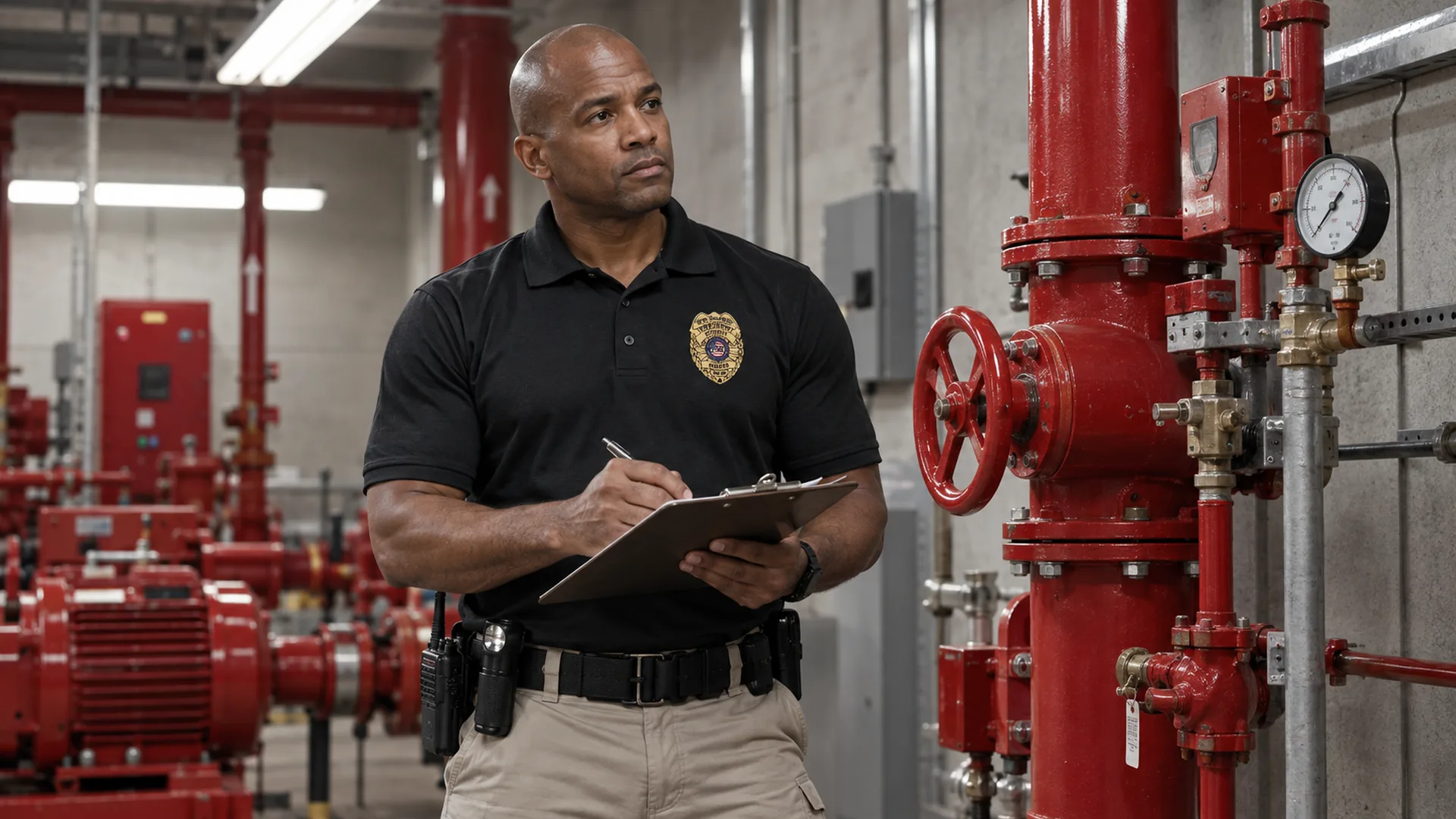
Most people hear the words “fire watch” for the first time from a fire marshal, a contractor or an insurer — usually with a deadline attached. A fire watch is a trained person (or team) continuously patrolling a building or area whose fire protection is impaired or where a temporary hazard exists, looking for signs of fire, ready to alert occupants and call the fire department by hand because the automatic systems cannot. This guide explains when it is required, what the guard actually does, what the log must contain and how to set one up fast.
When a fire watch is required
Fire codes adopted in Florida (the Florida Fire Prevention Code, based on NFPA 1 and NFPA 101, together with local amendments) require a fire watch in situations such as:
- Sprinkler system out of service for more than a short period — repair, renovation, water main work, frozen or broken pipes, a failed pump.
- Fire alarm system impaired — panel failure, monitoring outage, construction that disables detectors.
- Hot work — welding, cutting, grinding, torch roofing — during the work and for a period afterwards.
- Occupied buildings under construction or renovation where protection is not yet complete.
- Assembly occupancies and special events where the fire marshal requires it because of crowd size, pyrotechnics or layout.
- Loss of water supply, standpipe impairment, or a fire safety violation where the marshal issues a fire watch order pending correction.
The authority having jurisdiction — usually the city or county fire marshal — decides. Their order typically states the hours, the areas, the patrol interval and how the watch is documented. Follow it exactly; it is what the inspector will check.
What a fire watch guard actually does
- Patrols continuously on a route that covers every area required by the order — every floor, mechanical rooms, storage, parking garage — within the interval the marshal sets (often every 15, 30 or 60 minutes). No other duties during the watch unless the marshal allows it.
- Looks, listens and smells for fire, smoke, overheating equipment, blocked exits, propped fire doors, extinguishers missing or discharged, hazardous storage, and hot-work residue.
- Knows how to raise the alarm by hand — where the pull stations are and whether they work, how to notify occupants (air horn, voice, building PA), and calls 911 immediately on any sign of fire. The guard does not fight the fire beyond an incipient stage with an extinguisher, and only if trained and safe.
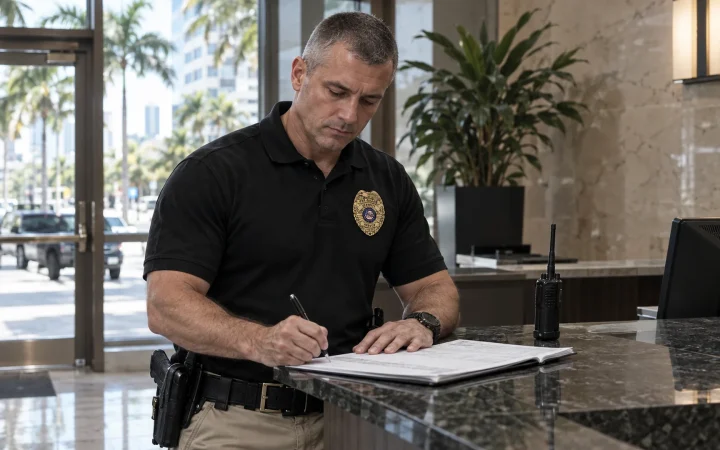
- Keeps the log — time of each round, areas checked, conditions found, actions taken, initials. Inspectors read the log; a gap is a violation.
- Knows the building — exits, utility shutoffs, the fire department connection, the alarm panel location, contractor contacts and the property manager’s number.
- Reports — a shift report to the property manager and immediate notification of anything that changes the risk (a new hazard, a door that will not close, a contractor leaving hot work unattended).
The fire watch log
A compliant log usually contains: property name and address, the reason for the watch and the marshal’s order reference, date, officer name and license, start and end of shift, each round with time and areas covered, observations, notifications made and to whom, and the time the system was restored. Keep it on site, available to the inspector, and give the owner a copy at the end. FSO Guard officers keep a paper log plus GPS-verified checkpoint scans that produce a time-stamped report.
How many officers you need
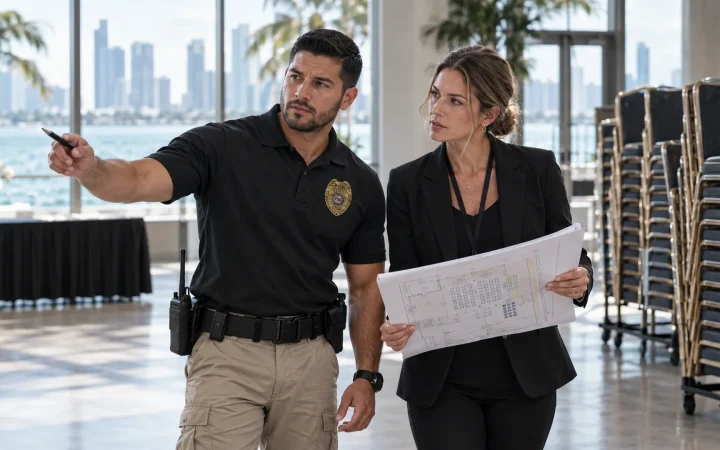
Enough that every required area is covered within the interval. A small office building may need one officer; a high-rise, a warehouse with long aisles or a campus with several buildings needs two or more, or a rotating team for 24-hour coverage. The site walk on day one sets the route and the headcount, and we tell you if the count can drop once part of the system is restored.
How long it lasts
Until the condition ends and the fire marshal accepts it: for an impaired system, until the repair is complete, tested and re-inspected; for hot work, until the post-work monitoring period ends; for an event, until the venue is cleared. Because a system impairment can run for days or weeks at 24 hours a day, the single biggest cost lever is speed of repair and re-inspection — push your contractor and schedule the inspection early.
Setting up a fire watch fast — a checklist
- ☐ Get the fire marshal’s order or the code requirement in writing (hours, areas, interval, log format).
- ☐ Notify your insurer — many policies require notice of an impairment and a fire watch.
- ☐ Call a licensed security company; send the order, the address, floor plans if you have them and a site contact.
- ☐ Site walk with the first officer: route, pull stations, exits, panel, shutoffs, hazards.
- ☐ Post the emergency procedure and contact tree at the officer’s station.
- ☐ Set daily reporting to the property manager; keep the log on site.
- ☐ Schedule the repair and the re-inspection; notify the security company when to stand down.
Fire watch services in Miami-Dade, Broward and Palm Beach
FSO Guard provides licensed fire watch guards for condominiums, offices, hotels, warehouses, construction sites and events — dispatched within hours, 24/7, with logs and GPS-verified rounds that satisfy the inspector. We also cover construction site security, warehouse security and overnight security when the impairment overlaps with other risks. Call (786) 659-5011 or message us on WhatsApp with the fire marshal’s order and we will quote and dispatch the same day.